

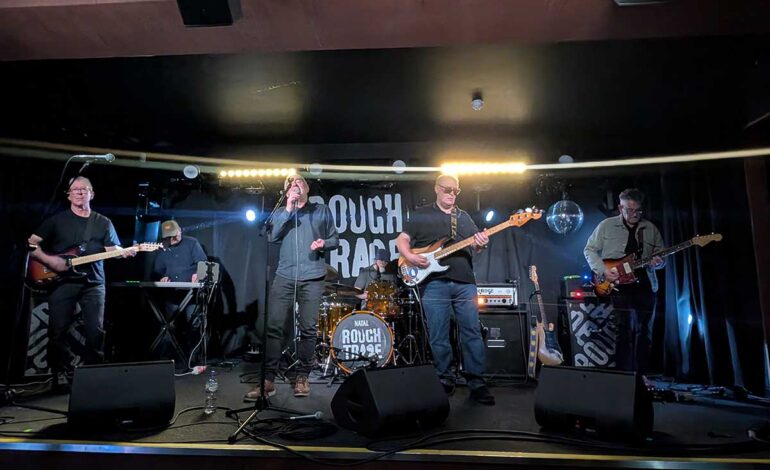
For many music fans, Noel Burke will always be remembered as the man who replaced Ian McCulloch in Echo & The Bunnymen.
It’s a role that came with enormous pressure, intense scrutiny and the near-impossible task of following one of the most distinctive frontmen of the post-punk era. Yet as Burke reveals on the latest episode of Misadventures in Music, his journey to the front of one of Liverpool’s most celebrated bands began hundreds of miles away in Belfast.
Speaking to Prowsey and Mick, Burke recalls growing up during the troubles, when music offered an escape from the realities of everyday life. By the late 1970s, it seemed as though everybody was forming bands, and after a brief and unsuccessful stint as a bass player, Burke found himself being encouraged to step behind the microphone instead.
That decision would ultimately lead to the formation of St. Vitus Dance, a band that steadily built a reputation throughout Ireland and earned critical acclaim despite operating far from the spotlight enjoyed by many of their contemporaries.
The Belfast music scene was vibrant but challenging. Venues were limited, opportunities were scarce and success often meant looking beyond Northern Ireland’s borders. For Burke, Liverpool became the obvious next step.
The move proved to be a turning point.
After bringing St. Vitus Dance to Liverpool, Burke quickly fell in love with the city’s atmosphere and musical heritage. What began as a handful of gigs soon became a permanent relocation as the band attempted to establish themselves on the mainland.
It was during this period that fate intervened.
Burke laughs as he recalls the strange circumstances surrounding his recruitment into Echo & The Bunnymen. While working in Liverpool, he became aware that members of the band were quietly checking him out before a formal introduction was made. A meeting at the Philharmonic pub followed, along with the phone call that would change his life.
At the time, Echo & The Bunnymen were facing an uncertain future. Ian McCulloch had departed and drummer Pete de Freitas had tragically died in a motorcycle accident. Many assumed the band would simply come to an end.
Instead, Will Sergeant and Les Pattinson chose to continue.
For Burke, accepting the invitation meant stepping into one of the most demanding jobs in British music.
The result was Reverberation, the 1990 album that remains one of the most debated releases in the band’s catalogue.
More than three decades later, Burke speaks about the experience with warmth and perspective. While some fans struggled to accept a new frontman, he remembers a band determined to move forward rather than become trapped by its past.
Touring the album became a crucial part of that process.
By the second tour, Burke believes the group had developed into a formidable live act. Listening back to recordings today, he remains surprised by just how powerful the performances were. He reserves particular praise for Will Sergeant and Les Pattinson, whose unmistakable playing ensured that, regardless of who stood at the microphone, the essence of Echo & The Bunnymen remained intact.
The conversation also touches on drummer Damon Reece, who had the equally difficult task of following Pete de Freitas before later going on to enjoy success with artists including Massive Attack.
What emerges throughout the interview is not a story of replacing Ian McCulloch, but of a musician navigating an extraordinary opportunity while remaining true to himself.
For many years, the Reverberation era sat somewhat awkwardly within the wider Echo & The Bunnymen story. Listening to Noel Burke today, however, it becomes clear that this chapter deserves to be viewed as more than a footnote.
It is the story of a Belfast musician who followed his instincts, crossed the Irish Sea in pursuit of a dream and found himself at the centre of one of the most fascinating chapters in Liverpool music history.
The full interview with Noel Burke is available now on Misadventures in Music, where he discusses St. Vitus Dance, Belfast, Liverpool, Echo & The Bunnymen, songwriting, touring and much more.




1 Comment
[…] as most people don’t regard Reverberation as the Bunnymen, it is hard to accept the tracks that are minus Will as being the Bunnymen […]