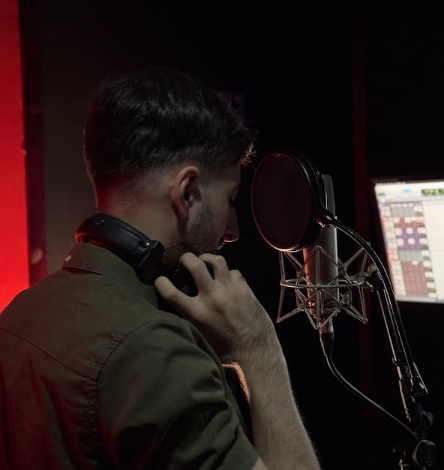

Red Head Redemption’s Sunny With A Chance Of Fallout turns an increasingly uncertain world into something energetic, rebellious and unexpectedly joyful. Blending punk-infused rock, satire and apocalyptic storytelling, the band confronts political extremism, technological anxiety, environmental decline and the pressure to live authentically without losing its sense of humour. Across the EP, anger sits alongside romance, humour alongside fear, and a determination to keep creating in the face of uncertainty.
We caught up with Red Head Redemption to explore the ideas behind their “End of the World Rock,” the collaborative chemistry at the heart of the band, and the expanding fictional universe they are building around their music.
Sunny With A Chance Of Fallout presents a fascinating contradiction: the world feels increasingly unstable, yet the record is full of energy, humour, rebellion, and a desire to keep living fully. When did you realise that this tension could become the central philosophy behind Red Head Redemption’s “End of the World Rock,” and how has that idea shaped the band’s identity?
As we were writing Armageddon Beach Party, the palpable static of doom in the air just kept ringing in our ears. The news, evil tech, AI takeovers, it all just bled itself into an (almost) laughably horrible existence for humanity. We’re all out here trying to make music and be creative, to pursue our dreams in the way we are told to from infancy and the world is falling apart before our eyes. But art has always existed, even during the plague, during both World Wars, during every horrific thing that has ever happened in history, art has still turned in the background. So we will be the art at what feels like the end of the world as we know it.
The EP seems to explore the strange experience of living an ordinary life while being constantly confronted with extraordinary levels of political, environmental, technological, and social uncertainty. How do you personally navigate that contradiction, and did writing these songs change the way you think about the world you are living in?
We are all living in a sickening era of contradiction, peddled to us by generations before stating “if you work hard and keep your head down, you too can have the American dream!” We now know that’s absolutely BS. Plenty of people worked hard, put themselves into debt to become highly skilled, and now they’re being edged out of the market by robots who do the job worse and heat the planet while it’s happening. Everyone whose head isn’t up their ass is confronting this truth more and more every single day. And yet, the sun rises, capitalism beckons, your family and friends are still there loving patiently. What do you do? In ABP, we included an increasingly urgent series of famous speeches, the first an anti-fascist speech from the times of WWII, the second an anti-capitalist message, and the final a call to not give up, to not be afraid. Music can be the thing that gives you hope when it feels lost. We want to tell the world that we see and acknowledge the horrors, but we’re far from giving up. We are going to fight the machine with art, activism, and our voices until we can’t anymore.
The fictional Nile Tech Industries introduction is a particularly intriguing piece of world-building, especially with its “We Own Everything” slogan and gas mask coupon concept. What inspired you to create this fictional corporation, and how important is satire to the way Red Head Redemption communicates ideas that might otherwise become overly serious or didactic?
The intro track was inspired by an actual nuclear fallout post that popped up on instagram while scrolling. It was like “oh cute puppy” BAM nuclear fallout warnings in a pretty, curated post, and then an ad for makeup blah blah. I immediately went downstairs and recorded the creepy advertisement. And then the name of the company itself had to be inspired by the big perpetrator, but not too on the nose. Instead of the biggest forest, it’s the longest river. When we stopped to think about a world where we assume the worst has happened, we are living in active fallout, of course the elites would use that time to create an ad. You can’t even go to the beach without a plane flying into the sky, even after you’ve already paid to be on the beach that should be free. They use every spare moment you’re awake to send you messages, obvious and subliminal, to buy things because that’s what capitalism demands. To think that that would stop even if the world were in nuclear winter is absurd. They’ll sell you back clean air that didn’t need to be poisoned to begin with. Using satire to communicate this means it pokes fun at what’s impossible to avoid, because if you’re not laughing then it’s likely you’ve lost all hope entirely.
“Armageddon Beach Party” manages to combine an infectious rock sensibility with some deeply unsettling ideas about political extremism, technology, and the possibility of becoming desensitised to the collapse happening around us. What did you want listeners to feel when they heard the song for the first time, and was there a particular moment in its creation when you realised what the song was really about?
The switch in the bridge really is a shining moment for many reasons for us; the first is the layered political speeches, but also it shocks the listener. The song starts, you’re mad and pissed off, but then you lull yourself into a comfortable dance. You’ve accepted your fate and you’re just living in that truth for a moment. Then the tension starts building again, you’re waking back up and tuning back into reality. The speeches are the final cry of action, do not be afraid, do not stop fighting. And then we’re back and louder, more insistent. These are the true ebbs and flows of a modern informed person taking in the news everyday that seemingly gets worse and worse. We’re mad, we numb, and then we have to shake ourselves awake so we can jump back into action.
“Race Against Time” shifts the EP from broader social concerns toward something much more personal: the fear that we might reach the end of our lives without having truly lived on our own terms. What does living authentically mean to each of you, and has being in a band changed your understanding of what it means to make meaningful use of the time you have?
Kim: I lost my Mom when I was 26 and it killed my spirit. After spending much of my life in pursuit of what I thought everyone wanted me to be, a corporate climber making her way out of poverty by her bootstraps, I realized “Oh my God – I am miserable” After ruminating about it, I realized music was the dream that I could never shake from the back of my mind. I was constantly quietly wishing I could go back and pursue music instead of corporate America the way I was told. That felt especially keen when my marriage failed and I had to confront how much of my 20s were spent trying to make everyone else happy instead of myself. It’s also this confrontation at every crossroads of “am I making the right decision?” Because we never really know until we’re at the end if we lived in a way that made us truly happy. I’d rather recognize that now and try to be more authentic than feel like I wasted my one life to live. So this song serves as a reminder to everyone to check in with yourself, because the clock is ticking.
Bryan: Back in February I had a health scare involving my heart that involved me ending up in a hospital after a show we played. Ironically enough it was the weekend of the show where we debuted this song. That event really put a lot of things into perspective for me, I’m not going to be here forever and I want to make sure I make an impact with the time I’ve been given on this earth. Time is fleeting and life has a 100% mortality rate, none of us are getting out of here alive and it’s up to us to do with that time as we see fit. Do what matters, have fun, go out with friends and have a good time. My biggest fear is that when I’ve reached the end of my time that I didn’t do enough with that time I was given.
Chris: Our time on Earth is a limited one and I can only hope to be remembered as providing a net positive to the world. But, in the final judgement of the totality of my life, it is largely out of our hands. Although we can influence how we are remembered by our work, its impact, and our willingness or unwillingness to participate in events that will determine the future, it’s up to future generations to decide whether we did it right. That being said, I think one of the reasons people come around to making art, building communities, and even having children in “doomsday” times is that they realize their progeny may have a chance to do some good after they are gone.
But when it comes to making music, personally, I think one’s work can be a reflection of the truth but it comes down to the audience considering what you created and then, possibly, integrating it into their own way of thinking. Because, at the end of the day, music and words can inspire and the songs can function as a kind of “soundtrack to the revolution” – but it isn’t the revolution itself. The work still has to be done. Anyone telling you otherwise is trying to sell you something.
Phil: Living life authentically for me is carving your own path and taking in advice from others but not letting others opinions dictate your decisions. Being in a band there are always outside people with opinions of how you should be making your art but you just take it lightly and stay true to your vision. In a way making music leaves a print on the world that transcends time.
Ken: I’ve always been the type to march to the beat of my own drum. Life has always been more exciting that way. Growing up my younger sister was in and out of the hospital for a seizure disorder constantly. My parents never wanted to lie to us and say all was going to be alright. Instead they said that they didn’t know if my sister was going to be ok. I think, as a result of the potential death of my younger sister looming over me (she is fine now) I became familiar with the idea of death and as a result think about the idea of it often. I’m grateful for that honesty from my parents. The recognition of mortality makes you more empathetic and makes life more beautiful. You appreciate little things and little moments. The phrase “Memento Mori”, which means “Remember you will die”, has become a personal motto. This is all temporary and one day it’ll be over. So I want to make the time I have count.
“Jolene” brings a different colour to the EP through its surf rock influence, while still fitting into the record’s larger philosophy of love and rebellion in an unstable world. Why was it important to include that sense of romance and playfulness, and what does the song reveal about Red Head Redemption that listeners might not discover from the more overtly political material?
At the heart of every single person is someone who is seeking love and fighting for it with every fiber of their being. again, throughout all of time, love has existed during the darkest of times. There were babies being made during the Dark Ages, otherwise we would not be here. There are records of lovers and love affairs happening during war time, famine, etc. Why wouldn’t someone, at the end of the world, still be fighting Jolene for trying to take her man? If the Earth is polluted, and we’re all doomed, it seems love might be all we have left, and it’s something capitalism can never fully own.
Your influences include The Pretty Reckless, Joan Jett, Avril Lavigne, and Veruca Salt, artists who each brought a strong sense of personality, independence, and attitude to rock music. What have you learned from those artists about songwriting and performance, and how conscious are you of finding a balance between honouring your influences and making sure Red Head Redemption sounds unmistakably like yourselves?
These artists all have common ground, and it’s attitude with a strong woman at the helm who will not be tamed. I think watching The Pretty Reckless absolutely smash their tour right now, rising from the ash of what she (Taylor Momsen) is known for, and just blowing apart the image that everyone has of her in their minds of “sweet innocent kiddo” is exactly what I’m going for. I was known for most of my life as the goody, follow the rules, do what you’re told type. And now I make my own way and I don’t let anyone tell me how to live or approach my music. Avril has a similar vibe. She’s very much in the camp of “this is who I am, take it or leave it, but I’m not changing for anyone.” The way we differentiate ourselves is entirely influenced by the creativity of our ability to share ideas and build music in tandem. 9/10 when we’re writing, it’s a collaborative effort, so we all bring our musical tastes into the mix. Phil (our rhythm guitarist) is always coming up with genius new riffs that break the mold, and then we get to blend that into a more classic rock style which is Chris’s (our lead guitarist) passion. The ingenuity of the rhythm section is how we set ourselves apart. We don’t shy away from tempo changes that flirt with latin genres or the double-bass that stems from musical influences in the metal space. together, we all just say a collective yes to everyone’s ideas, and that’s how we make a sound that is uniquely us.
Doug Hallo produced the EP, while the songwriting and instrumentation involve a distinctive combination of vocals, lead guitar, rhythm guitar, bass, harmonies, and drums. How does the chemistry between the members affect the songs once they move from an initial idea into a full-band arrangement, and were there any tracks on this EP that changed dramatically during that process?
Bryan: Band chemistry is paramount. When we write a song we write it as a unit. Typically one of us comes up with a riff, we build it up and tweak it as we go. Slide parts in and out, shift things around and structure the song until we’re instrumentally happy with it. Then Kim comes in with lyrics and melody, we decide if there needs to be backing vocals, gang vocals or harmonies and flush it out with all those things in mind.
Chris: There’s some back-and-forth over song structure and basic ideas that get introduced by individuals but each band member contributes fairly equally to the greater whole. There’s no one person who dominates the songwriting process and I think, in that mix of each person’s contribution, you get that real band chemistry.
Ken: One of us typically presents something, a catchy riff, an idea, a chord pattern, or even a fully fleshed out song. Then once we establish the direction of the song and we start bouncing ideas off of each other. We always go with what sounds the best and what really brings the song to life. I honestly think that’s what gives our music the most soul and what makes it sound so great is all of the songs, regardless of who had presented the initial piece there are always 5 great songwriters working on it with the same care as Michelangelo painting the Sistine Chapel.
There is a strong sense throughout Sunny With A Chance Of Fallout that humour itself can be a form of resistance. Do you think people sometimes underestimate the cultural or political power of humour, particularly when confronting subjects as frightening as authoritarianism, environmental decline, corporate power, or technological control? Can making people laugh sometimes allow an idea to reach them more deeply than simply telling them what to think?
We definitely think humor has the ability to reach people. In fact, oftentimes there is a correlation between people who are inherently funny and intelligent. People like Bo Burnham are a prime example. Sometimes you have to laugh first before you can think and reflect on something in a deeper, more meaningful way. A punchline sometimes sets up a connection you would never anticipate if you look at a scary modern problem head on. That’s why using satire works so well. It makes you realize, oh wait, it’s funny and terrifying that the world is run by evil wealthy elites cosplaying as literal super villains out of movies. Like, do they not even reflect on how laughably evil they are? It feels so obvious to us, but I really do wonder how no one close to them says “hey have you ever realized you’re like every really bad villain in every cheesy movie about the end of the world ever written?” It’s cliche, and ultimately horrifying. Humor also has the power to reach those who are stubborn. If someone is trying to numb themselves, getting them to listen to a satirical intro will make them chuckle but also confront the reality we’re living in. There is no space to be numb now. We have to stay awake and pay attention to what’s happening or this is the lived reality coming for us all.
With three releases now available and the band’s fictional universe beginning to expand through the planned music videos, it feels as though Sunny With A Chance Of Fallout is part of something larger rather than an isolated release. Where do you see the Red Head Redemption story going next, both musically and conceptually, and what would you most like audiences to understand about the band that they might not get from simply pressing play on the EP?
Conceptually we are working on a series of music videos. Armageddon Beach Party is top of that list. We are taking the universe we created and expanding it tenfold into a storyline where the band are both the rebellion and working under the radar for “The Man” That we are extremely excited to dive into creatively and cinematically. One thing I want folks new to our music to know and understand about us is that we are nothing like what you’ve heard before, and we’re just getting started. We welcome everyone into our world and want to build a global fanbase so we can tap into relevant stories all over the world.