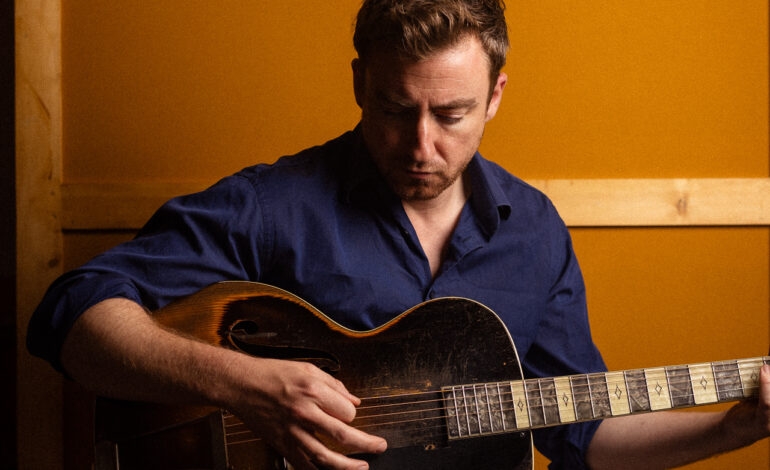

For Dan Thomas, music isn’t just a craft — it’s a lifelong tug-of-war between raw energy and reflective vulnerability. From his early days screaming over distortion in hard rock and metal bands to finding a surprising home in the acoustic and folk world, Thomas has built a career on refusing to choose between power and honesty. His songs are confessional without apology, melodic without compromise, and delivered with an intensity that feels instantly identifiable.
Now, as he prepares to release his newest single and gears up for a full album arriving on his 40th birthday, Thomas reflects on a creative journey shaped by Napster nostalgia, punk-rock influences, midlife recalibrations, and a renewed desire for real human connection in a hyper-digital age. In this candid conversation, he opens up about the origins of his sound, the challenges of the online attention economy, and the delicate art of knowing when a song is finally “finished.”
When did you first fall in love with music?
It’s hard to pin down the exact moment that it happened, but there are two that come to mind. The first was watching Back To The Future when I was 12 years old and seeing the scene where Marty plays Johnny B Goode at the dance. Something came alive and made me think “I wanna do that!“. The second was when I was 14 and my friend Joe and I used to swap songs with each other over Napster (I know…bad musician, pirating music!). One of the songs he sent me was One Step Closer by Linkin Park. That song was my awakening to heavier forms of music and solidified my desire to play it above anything else that I wanted to be doing.
You’re known for bringing rock energy to acoustic performances — what’s your secret to keeping that spark alive on stage?
Interestingly, I feel like the answer here is contained in the question itself – it’s that rock energy that is in itself the spark that drives the performance. I got my start in music as the vocalist for a bunch of hard rock and metal bands in my teens and 20s, so that kind of energy is something I was forged in very early on. Then when I first set out on my solo career, I was playing guitar live for the first time and I was definitely not used to having that kind of restriction in my movement – you can’t run around jumping up on bass-bins and dance around on stage when your microphone is being firmly held in place on a stand – so I was keeping everything small and this started to inform the kinds of songs I was playing and writing. I thought that entering the acoustic and folk scene meant that everything had to be delicate and subdued. It was only through rediscovering artists like Frank Turner that I realised “Oh yeah, acoustic guitars can rock too!” and that allowed me to return to that well and bring something more “authentically me” to my performances.
How did your background in Hard Rock and Heavy Metal shape your approach to folk songwriting?
I’d say that playing in those early bands gave me a really solid foundation in lyric writing and particularly in crafting a vocal melody (with one exception, I never wrote any of the music in those days as I didn’t play an instrument, so my domain was the melody and the lyrics) and I think that allowed me to explore how to craft the music itself so that I was able to accompany my songwriting. It’s a lot easier to develop yourself in an area like that when you don’t feel like you’re sorely lacking in the other areas too.
Can you take us through your songwriting process — from idea to finished track?
It does vary from song to song, but more often than not, it’ll look like this: I noodle around on guitar trying to find a chord progression that I like (I find a good starting point is learning songs of other artists that I like to see how their songs are constructed and seeing if there are any chord progressions in there that interest me). Once I’ve found that and a rough rhythm and tempo that feels right, I’ll hum or make phonetic noises over it trying to find a melodic hook – this to me is the critical component of songwriting: I need to find a hook that I like, something catchy that gets into your head like an ear worm. If I can find that, then I know that I’ve got something worth developing (my wife gets super annoyed by it because she’ll find herself going about her day randomly humming it and then cursing me out loud for getting it stuck in her head – that’s when I know I’m on to a winner!). After that, I’ll think about what the song is about (the chords and the melody will usually define the tone – happy, sad, angry, etc) and write something that’s just “stream of consciousness”. It doesn’t have to rhyme, it doesn’t even need to feel like a song, it’s just me spewing forth all of my thoughts and feelings on the subject as they come to me. That will usually lead to some ideas or turns of phrase jumping out at me that informs the lyric writing and it’s a helpful document to have if I ever feel like I’m getting lost for what I’m trying to say. This whole process is not always in one go, mind you. Sometimes, I’ll have a 30-90 second voice note on my phone of me having found a chord sequence with a melodic hook that will sit there unused for months or years before I go back to the well for ideas and something about it will present itself to me as being the right idea for the moment.
Do you write lyrics or melodies first?
It’s usually the melody that comes first, but it’s not always the case. I’ve had one or two songs as a solo artist (and a few more in my time playing in bands) where the lyrics came before the melody and even one example I can think of in my solo career where the lyrics came before any music at all. But since the melodic hook is my primary barometer for whether or not I’ve got a song that’s worth developing, that’s usually what comes first.
How do you balance vulnerability with confidence in your songwriting?
Blimey, that’s a great question! I consider myself very lucky that I’ve now had the better part of 25 years performing and writing songs to really practice and develop the skills involved and that’s a great way to build confidence in any area – just by trying, failing and learning. It definitely helped that I was writing with other musicians in my days playing in bands – in my very first “proper” band, our guitarist Gary [Ogilvie] wrote the music and the lyrics when we first started out and that gave me both someone to learn from through observation and, subconsciously, a safety net to start writing my own lyrics as I knew that there was someone else there who could guide me or even take over if I was utterly useless at it! With all that said, I don’t think there’s a single person on Earth who doesn’t have vulnerabilities and learning to mine those vulnerabilities and channel them into art is something that has really shaped me as a songwriter. Whilst I’ve dabbled in writing songs about fictional characters in order to tell a story, I find that my comfort zone is to be confessional: To lay out parts of myself that have weighed on my mind or given me joy.
What challenges have you faced as an independent artist in the digital era?
Standing out amongst the noise? The rise of the attention economy is something that I just didn’t see coming and, just in my lifetime, there are now SO many more avenues your attention can wander down. I’m not going to go on a cliched rant about TV only having 2-3 channels “in my day” (I’m a mid-tier Millennial, so Channel 4 was well established in the UK before I was born, although I do remember the launch of Channel 5), but the way we consume art has changed massively in the time that I’ve been playing music. In many ways, that’s been a good thing – there are fewer industry gatekeepers than ever before and a lot of people able to make and distribute art that never would have been able to in times gone by – but it’s come at the cost of not knowing where on Earth to look or how to get eyes (or ears) on your work.
Were there any musical influences that shaped the sound of this single?
Frank Turner has been a pretty big influence on this and the upcoming album that’s due for release next year (27th April 2026, my 40th birthday – I’m celebrating my midlife crisis in style!), but I can remember a bunch of different artists that informed the sound I was going for, both in the writing and the production. Rise Against were an influence in the vocal melody for the chorus (I even toyed with the idea of seriously upping the tempo early on in order to evoke that early style of their first 2-3 albums, but wisely decided against it!), Foo Fighters influenced the sound of the guitars (and the song ‘All My Life’ was subconsciously being channelled in the arrangement for the breakdown), Coheed & Cambria inspired the lead guitar melody and Bad Religion’s use of multi-part, Beach Boys style “Ooh” and “Ahh” harmonies in the backing vocals was something I was very consciously drawing from (another influence of mine, a Canadian Psychobilly band called The Creepshow, also make use of similarly-styled backing vocals and I was definitely thinking about them too).
How do you know when a song is truly “finished”?
Another great question. There’s obviously a very nuanced conversation to be had about when a song, or indeed any piece of art is done (there’s that great quote about how works of art are never completed, only abandoned), but I’ll save us from getting really stuck in the weeds there! I’m lucky in that most of my songs are fairly obvious when they’re “finished” – I don’t write songs with any kind of complex structure, it’s usually a variation of “verse, chorus, verse, chorus, middle-8, chorus, end” – but every so often I do find myself having written a song that SEEMS like it’s finished…and there’s something not quite right about it, like a portrait painting that you could SWEAR was missing a facial feature, but you can’t say exactly which one. There’s another song on the album which I’m releasing early in the new year as the next single that had a gestation period like this: It was essentially “done” for months, but every time that I rehearsed it as written in consideration for a live set, it didn’t feel right and I’d ditch it from the set list. Eventually I worked out that it was missing a chorus near the start of the song and needed one line of the chorus reworking and then the whole thing fell into place – it’s now one of my favourites, both on the album and to play live, so I’m really glad I persevered with it!
How do you stay authentic when social media often pressures artists to “perform” offstage as well?
This is something that I find really hard to deal with and it comes back to what I was saying earlier on about the changes in the media landscape in the digital age. I’ve spent much of the last year reassessing my online habits, particularly when it comes to social media, and have taken a major step back in how I use these platforms. I think that, while it’s undeniable that some people have found social media to be beneficial to their lives, the vast majority of us are left feeling lonely, angry and depressed from using it and that goes double for creative people existing in those spaces. We’re left feeling like we’re screaming into the voice, hoping that people will hear us, whilst it looks like all of the other artists we know are living their best life (because that’s what their highlight reel looks like), so we think that WE’RE the one who’s failing. And that keeps you coming back to play the social media game out of desperation. All of this is what fuelled the writing of the single in the first place. I think these days I’m much more aware that the offstage performance that goes on online that you describe is not very authentically me and that the best way for me to stay authentic is to not do that. I am at my most effective when I’m out in the real world in front of people playing my songs. We’re a social species that, in the main, thrives on gathering and connecting with others in our tribe, so I don’t think I’m alone in feeling like face to face interaction is where I’m at my best. This is the part of the human experience that I think social media cannot replicate and, in a lot of ways, is actively making our lives worse by atomising us all more and more. But, to end on a hopeful note, I also think that, because of this, social media is heading for a reckoning very soon. More and more people are getting to grips with just how bad this is for us all and before long, I think that enough people will have decided that they’ve had enough and abandon it altogether. Am I being naïve? Possibly, but having spent time living in despair, I prefer to live in optimism.
PR: Decent Music PR