
The tracks kind of presented themselves to me as, when I would pick up my guitar around the house, they would be the ones I’d find myself working on. Or I would hear grooves in my head and start piecing them together with these songs and after a while I had ten songs that I’d basically rearranged and I thought they’re ready to go into the studio with, so that’s what I did. I have a whole published book of my own lyrics which I keep at home and sometimes I just flick through randomly and start working on an arrangement for a set of lyrics in there – a couple of them happened like that.
What does the album title The Union mean to you personally?
So at first this was a retitling of one of the songs on the album, there was a song called ‘The Human and His Heart’ and I thought that was too clunky, so The Union sounded bolder and had more impact. Then I thought well actually that’s a good name for the whole album. The meaning of “union” within the song is the union of mankind with its collective heart, as in don’t let progress, technology and intellect detach us from the love that earths and connects us, which in my experience is found in the most simplest of places and exchanges. So that meaning is in the overall album title and I’d like that message to run through all my music and everything else I do. I asked my wife to be on the album cover which made me realise I’m also celebrating our union with the release of this album. There’s also union with my audience, union with my bandmates; so I think that is the statement I’m making, that I’m ready to enter that union with all those people.
You’ve got over 150 unreleased songs—how do you archive or revisit such a large body of work?
Like I mentioned I published a book of lyrics and poems, so a lot of my lyrics I just find in there in my copy. I have all these collections of handwritten lyrics and chord progressions too with covers I’ve drawn for them, so I’ve been organised along the way. But most of the time I don’t need to revisit them as the songs sort of float up into my consciousness when it’s the right time for them to be heard, often in a new arrangement.
Has your songwriting process changed significantly over the years?
I think it has become much more internal, almost entirely so at times. It’s sort of become that way out of necessity as I have young kids and I’ve had to find new ways of working on my ideas – I can’t just sit there with my guitar for hours like I once could. But I also find it more effective to work on songs inside my own head as I’m not getting swayed by any habits or instincts on an instrument, so the ideas are coming up from my unfiltered inner musical voice. Another change would be my chord progressions, I incorporate a lot more jazz and gospel chords into my songwriting than when I started and I look for the special substitutions that really make something sound authentic – it’s all in the details. Before I would think strongly in terms of words, melody and chords but now I consider those elements and how everything is sitting in the big picture as well. Are the horns taking up too much sonic space? Do they need to be simplified? Is there a cool backing vocal line I can think of to complement the hook? That kind of thing, so now I write and arrange simultaneously. I’ll keep track of any cool ideas by making voice notes along the way on my phone, then when I feel in command of all the various elements I’ll sit down in my (very basic) home studio and start making demos. For me it is a steady, step by step process. I don’t like to rush, I let the inspiration come when it will.
As a self-producing artist, how do you balance creative freedom with decision fatigue?
It is so costly to produce an album as a self produced, self funded artist that I don’t really get close to where I feel my maximum work load would be. I would, in an ideal world, put out 2 or 3 albums a year, so one a year means I don’t really encounter too much decision fatigue. I find it more challenging how slow it is to get my songs out properly as, being an independent artist, I have to make sure I’ve got the money to pay the studio, pay the musicians, before I can crack on with making stuff. I want to get all my unreleased work recorded and out there, so I can work on any new ideas that come. I’ve actually stopped writing songs (unless something just keeps coming up and then I will pay attention to it) because there’s just too much of a backlog right now.
Is there a theme or thread that ties the album together?
I don’t think there is like a narrative arc that runs through the album and I didn’t write the songs over the same period of time or with the intention of relating them all to each other. Albums are like energy capsules though and I do think working on this album like I did over the course of a year, has given it a particular feel and vibe, relating to my creative spirit during the time that I was making it. I’ve also used the art work to introduce the idea of union to the listener as a theme to explore in the work. More than anything else I think the music has its own journey, I’ve added an interlude section to ‘Baby’s Arms’ and fed one song into the next with ‘Pieces’ and ‘Gypsy Queen’ to adjust the rhythm and mood of the piece as a whole, the idea being to create a sense that you are listening to an extended piece of music rather than a collection of individual songs. I like that you can experience it in this way or as singles, as I made sure the songs stand on their own too.
What’s one track on the album (besides “Give You Something”) that surprised you during the recording process?
The first single ‘The Carnival’ surprised me. I was going into it thinking it should be like a latin inspired spicy disco song, and it keeps a bit of that, but the drummer and bass player gave it this really swampy rocky kind of drive which, when I heard what they were doing, I didn’t question but went with it entirely. But then, when we were doing horns for other songs on the album, the horn player and I listened to ‘The Carnival’ in the playback room together and started coming up with an arrangement, there and then in the moment, so we pursued that. The arrangement we came up with gave the tune a bit more of its latin/cuban type vibes back and the percussion and saxophone solo took it in a Afrobeat direction towards the end; so this tune definitely had more in its locker than I thought it would have.
Tell us about the concert film—what can fans expect?
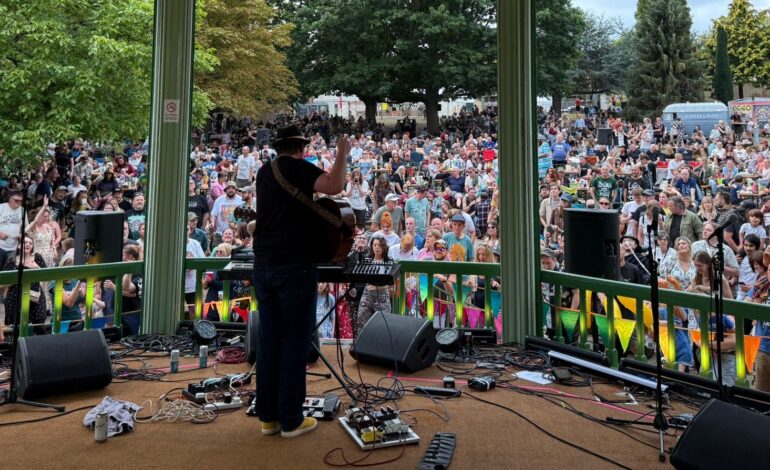
A very high quality live concert film, interspersed with little shots of my wife and I and other quieter contemplative shots. These are in contrast to the ultra high energy concert shots which we recorded at the physical CD launch of The Union. It was an amazing night and it’s rare that an evening like that is captured in such high quality B-RAW grade film and with such professional videographers on hand to capture it artistically – I feel blessed to have it. The performance itself is my 7-Piece band and I playing the entire new album live to a sold out crowd in my hometown Deal in Kent. We did it at The Lighthouse which is a venue known all through the UK for great music and the stars just aligned that night and we captured something memorable. I’m glad I’m going to be able to share it.
How do live performances influence how you produce or arrange your recorded music?
Quite a lot actually. When you are live, before a receptive audience, with everyone in the band feeling it, there is I think an extra 25% to be got out of the music then otherwise. Because of this heightened state, lots of musical things happen organically and songs tend to get better over time as the band gets tighter. So that’s how I’m doing the next album, I’m gigging the new songs before I’m recording them, to allow time for them to develop with the band. There’s the audience part too, it’s easy to see when something really works or when something falls flat. All of this is helpful for when it comes to writing and arranging, and is essentially called experience I guess.
What’s something you’ve learned about yourself through making The Union?
I’ve learnt that I’ve got the courage, patience and the organisational and communication skills to have a musical vision, and to meticulously go through every step of the process, until the vision becomes a reality. I’m proud of the way that I have taken care of every element of the project to make sure it was the best it could be, whether it be the album art work or the mixes. Overall I’ve learnt I can do it, and a lot of ways I could do it better next time too.