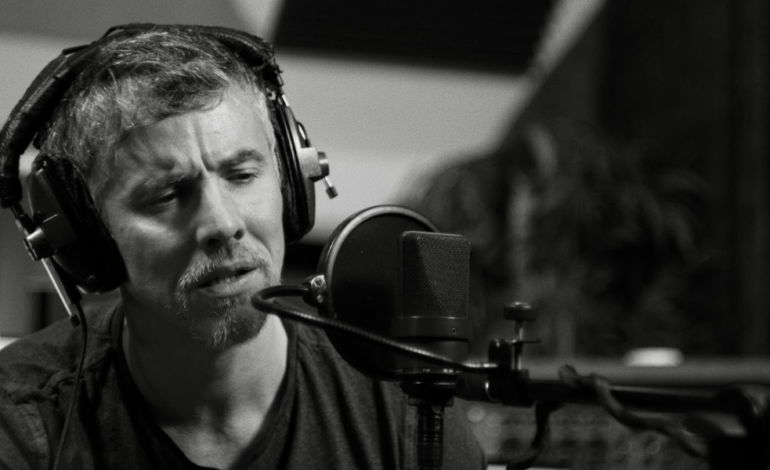
Billy Peake doesn’t mince words. On Manic Waves, the songwriter turns his attention to digital outrage, generational anxiety, fatherhood, and the strange emotional terrain of modern life with equal parts fury, wit, and vulnerability. Across the record, sharp political observations collide with deeply personal reflections, filtered through a sound that nods to college rock and new wave without ever feeling trapped by nostalgia. In this conversation, Peake discusses rage culture, humour as survival, the emotional risks of writing about family, and why he believes music should confront the present moment rather than romanticise the past.
The album engages heavily with digital outrage culture—what first made that feel like something worth writing about?
It was a progression. In 2016, America elected a vile, corrupt, perpetually aggrieved manbaby to be president. His whole campaign was built on rage tweeting. And his rise gave all of the other perpetually aggrieved manbabies license to be their worst selves, especially on Twitter. I think a lot about the images of white people in the American Deep South during the 1950s and 1960s, violently trying to stifle the civil rights movement and integration of schools. You can see the hate in their eyes. They are mostly anonymous, though, faces in an angry mob. But on Twitter, there are public figures just openly choosing to be on the wrong side of history. And it’s all chronicled for their future grandchildren and great-grandchildren to see. That was the obvious premise behind “Granddad was a demon.” Young people in the future discovering that their elders were total monsters. Of course, I finished the lyrics and wrapped that song well before yet another privileged manbaby purchased Twitter and AI became the ultimate disseminator of disinformation. So my hope that all these ragers will be outed and face a public reckoning is fading fast. The American public has decided that the truth is inconvenient. We’re desensitized to vile tweets and have now moved on to more important things like whitewashing history textbooks and banning classics. Any reader that has made it this far is probably like, “I’m sure this guy is a blast at a party!”
How do you personally separate (or not separate) the political from the personal in your songwriting?
It’s impossible to separate. But I do make a concerted effort to celebrate what I love just as much as I spout off about the dark stuff.
Several songs deal with family and fatherhood—how did becoming a parent change your voice as a writer?
I’ve always worn my heart on my sleeve as a songwriter. I sing about what is affecting me the most at that moment. So when I was younger, I wrote a lot of songs about the hypocrisy of radical right nutjobs. But I also wrote a lot of songs about getting drunk, being in a band, and resisting adulthood at all costs. Becoming a parent is simultaneously the most exhilarating and terrifying experience that I can imagine. It changed my entire perspective on life. You basically stop living for yourself. Your focus shifts immediately to the kids. And it should. Don’t get me wrong, I still have bouts of selfishness. But for the most part, my view of the world (and the way I navigate and react to everything) is based on how it affects the kids. So that perspective seeps into the songs.
Do you see humor as a coping mechanism in the album, or as a political tool in itself?
That is a great question! It’s probably a bit of both. For me, regardless of the medium (music, film, television, prose, poetry, whatever), I need levity. Vonnegut was the funniest motherfucker on the planet, even when he was writing about the horrors of war. Think of Radiohead’s OK Computer. On the surface, it’s miserable and insufferable. But then you hear the sing-songy manner in which Thom Yorke sings “kicking squealing Gucci little piggy” over that jaunty guitar line in “Paranoid Android.” Or the tenor of the computer voice in “Fitter Happier.” Those moments are hilarious. It’s all about the delivery. Without the levity, it would feel like a sledgehammer of despair. But those moments of levity keep you coming back for more.
How do you avoid writing songs that feel like “statements” instead of lived experiences?
You are breaking my brain. I’m not that smart. Seriously. But I will say that I have a decent bullshit filter that has gotten more restrictive with age. So if I sing or say something that triggers the bullshit alarm, I scrap it or rewrite it. Younger Billy was very self-righteous.
What role does anger play in your creative process—fuel, distraction, or something else?
I try not to lead with it. The last thing the world needs is another angry white guy, amirite? When it does surface, I make a concerted effort to quell it with humor or weird instrumentation or something.
Was there ever a concern about being too direct or too uncomfortable lyrically?
For sure. And I dialed back a lot of lyrics and themes because they made me uncomfortable. But I am also not a miserable, overly negative person. As a matter of fact, I’m naively optimistic. So it was natural for me to counter the dark stuff with rays of hope and light and dumbassery.
How do you reflect on generational shifts and disillusionment without falling into nostalgia?
Do you smell the smoke? The wires in my brain are short-circuiting. This may take an hour to explain. But the gist is that some people will be like, “hey Billy, listen to so and so, they sound exactly like New Order!” Or, “listen to this dude who sounds just like Otis Redding!” And I’m like, “if I want to hear something that sounds like New Order or Otis Redding, I will just listen to New Order or Otis Redding!” I reject purposely derivative music or ideas. I think this applies to nostalgia in lyrics as well. I appreciate music that has an old soul, or analog roots, but it also needs to have modern sensibilities. I love Anderson.Paak. Especially the Malibu record. There are moments where he sounds like a Stax recording artist. But the textures and lyrical themes have modern sensibilities. He’s not trying to recreate the past or ride a wave of nostalgia. He’s embracing his influences and drawing the listener in with familiar sounds, but then dropping bombs that speak to modern times. Although my music proudly has a mix of 90s college rock and 80s new wave DNA, it’s not thematically nostalgic. Or at least, it’s not meant to be nostalgic. I am trying really hard to mesh those classic sounds with thoughtful lyrics to create something unique that I personally love. And in turn, I hope other people will relate to it. If you have a friend who only listens to early R.E.M. and Blondie records but also happens to be terrified that we are living in an Orwellian hellscape, send ’em my record. Maybe it’ll strike a chord!
Which song felt the most emotionally risky to write?
Crimeny. You are digging! This answer could change depending on the day. But I was very careful about my delivery in “Annie, you’re a lightning bolt.” On one hand, it’s a love letter of encouragement and advice to my daughter. That part was easy. But the delivery needed to be right. I was cognizant of the fact that other women would hear this song, and women don’t need to hear some random dude advising them on how to flip the patriarchy. That’s why I asked Amelia Bushell (Extra Special) to sing with me. As soon as she embraced the lyrics and melody, I felt validated. Amelia’s performance is perfect. It’s incredible. I love how our voices work together. And in some ways, I feel like the magic in that song is that I get to sing directly to my daughter, and Amelia gets to sing it to the rest of the world.
What do you hope listeners misunderstand about the album—and what do you hope they don’t?
I kind of hope they misunderstand me. There are voices on this record I would not want to be confused with: the proud ignoramus, the tin-foil-hat-wearing maniac, the preachy jerk who thinks he’s figured it all out, etc. Of course I do recognize some of those weasels from my own worst moments. But I’m not celebrating them. I am exposing them. It’s almost an act of penance. What I’d hate for folks to miss is that it’s a record about right now. This anxious moment. The state of social and emotional purgatory we’re all navigating. As I mentioned in my earlier rant, this isn’t nostalgia, even if some of the sounds are familiar. It’s not a debut story or comeback story. I simply had to make this album so that I could make better sense of these times. Thanks for all of the thoughtful questions. Now I’m gonna take a nap.