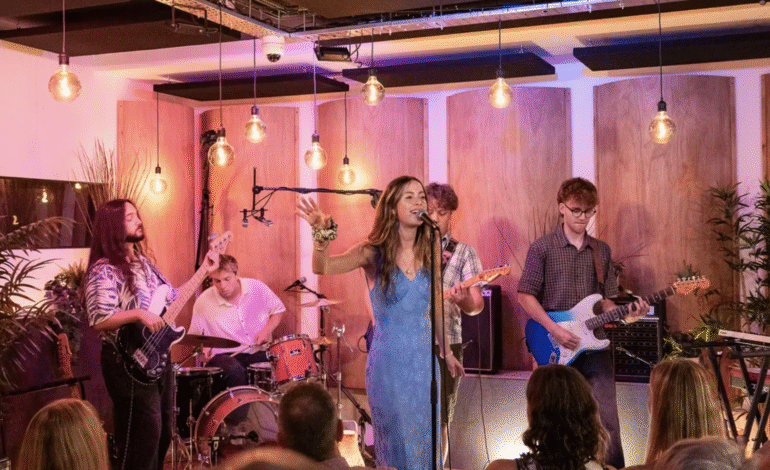
From captivating RnB tracks to heartfelt acoustic numbers, 6-piece band Berena delivers an effortless sound of soulful character, sublime vocal performance and instrumental prowess. Lead singer Josie Lomax conveys introspective and affectionate lyrics and uses her classical training to full effect to inform her harmonic approach. Isaac Tingay and Sam Devonport on electric guitars are capable of glassy and gritty textures in equal measure. Keyboards courtesy of Charlie Corry supply the chordal foundation of the group with his command of jazz harmony, and the rhythm section of Daud Kay on bass and Tom McNally on drums gives the ensemble its pocket through a unique combination of prog-rock backbone and latin flair. They have evolved into a fine-tuned collective, exhibiting a cool yet infectiously precise jazz-pop sensibility. After dropping their debut single ‘Just a Boy’ in 2024, Berena followed up with a stream of releases including an EP, each demonstrating their breadth of influence and depth of creativity better than the last.
The band are off to a flying start in 2026, having been featured on BBC Introducing for Radio Merseyside with their new single ‘When the Morning Comes’. This release is a groovy, high-spirited tune, with slick production allowing the layers of crunching guitars, warm keyboard textures and punchy drums to shine through. In the middle eight, bass licks and vocal runs dance around each other over a celestial bed of ambient synths. Isaac’s tasteful solo showcases a blues rock flavour while remaining true to the track’s sonic identity. Berena’s latest recording displays a distinct songwriting maturity, where each part is fully aware of its role while being able to confidently take a leading position at any given time.
In this interview we discuss their creative process, gigging experiences and what’s in store for the future.
What’s the last song you all listened to?
Josie: Oh this is going to be terrible. Can we lie? 2 Hands – Tate McRae
Sam: That’s alright, I’m happy with that: In Love With You – Erykah Badu
Isaac: We Don’t Have to Be Alone – Thee Scared Souls
Charlie: Endless Lovers – The Night Cafe
Isaac: If Tom was here his would have been shocking. He was banging the christian rock before football yesterday.
How did it feel to be on BBC Introducing?
Josie: The coolest thing.
Sam: To have it played by a proper radio DJ, it felt different to how you’ve ever heard that song before.
How do you think university life and music education has shaped the band?
Josie: I think the difference of the level that you are when you come into uni – before you’re doing it on the side as a hobby but then it becomes your assignments. You’re getting marked on everything you do.
Isaac: The shift of meeting more like-minded people. It’s inspiring to be around all the time.
You’ve got a great range of up-tempo R&B material, but also some slower acoustic numbers. How has the writing process changed during your time together?
Isaac: I think it’s changed over the whole time we’ve been together. With the new stuff it’s coming from us doing other things and having ideas and then bringing it in. We used to sit in a practice room and force something out where there were 6 parts to play and that was it.
Charlie: It’s always collaborative, but it’s started to become more externally collaborative. We used to just go in a room and play shit, but that takes hours and half the time you’ll waste the session. So a lot of the time now there’ll be a demo and go from there. People have time to figure out stuff on their own.
Sam: We’re writing a lot more in the studio as well, I think that’s a big shift.
Josie: It sounds more like it’s supposed to be a record.
Your tunes are pop-oriented but you’ve also got time signature changes and polyrhythmic elements. Is that all from Tom?
Sam: I think we’re all interested in alternative time and rhythm, we all like that sort of stuff.
Isaac: A big thing is drawing on lots of different stuff and then finding the middle ground.
I feel like with you guys it’s trying to do actually interesting jazz stuff but in a palatable pop format.
Sam: Yeah, it’s trying to do that but not showing off for the sake of it, trying to make it actually sound cool.
Isaac: That’s a shift with the new stuff as well in showing that we can do this stuff, but not in the sense of “listen to me play this”, but more “enjoy this”. Being discreetly flashy.
Isaac, we share a love of the guitar shredders like Steve Vai and Joe Satriani, but for Berena how does your mindset change for lead playing?
Isaac: Everyone’s confined by what everyone else is playing. Like if Charlie’s written a part for a song that fits, I need to be stylistically appropriate and not play 25 billion notes. I think I prefer to fit in a bit more.
Charlie: It’s just pretentious at times.
Sam: It wouldn’t sound good. It works better when all 6 of us are tight.
Does that mean your parts tend to be more composed and thought out than improvised?
Isaac: Yeah, it would sound messy and look really bad if it went wrong. When I’m playing some solos I’ll play similar things in certain sections but not the exact same every time. If it was a 4 piece there’d be a bit more room for that, but there has to be a conscious thought of keeping in your lane.
Sam: That’s the thing, there isn’t space. We write and fill songs out through improvisation, but we don’t tend to improvise much on stage.
Charlie: Improvisation for me is finding space to hit three killer notes.
Josie, could you talk about how your classical training impacts your vocal style?
Josie: I think it’s impacted a lot of harmonies. In the studio it’s impacted it more than I would make a melody. I was in choir and I’d be alto so you’re always on the harmony, so I’ve learnt a lot about that and what sounds good.
Sam, how would you describe your dynamic with Tom as co-producers? Are there aspects of where one of you will take the lead?
Sam: Yeah, it’s almost entirely split and kind of like a production line now. Tom’s better in the chair, when you think of a traditional producer.
Josie: He’s really good in the studio, talking to you while recording.
Isaac: He’s got a good way of explaining what everyone else wants, he’s very patient. And he’s just got a knack for knowing what fits.
Sam: Yeah, it’s much better to have that in the chair. But I’ll always be in there, looking at it from a much more technical approach. I set everything up, make the choices with recording and mics, and then do the mixing and mastering.
That’s a cool balance I think…
Sam: Yeah, Tom enjoys that bit and I really enjoy mixing.
Isaac: The workflow’s been refined as we’ve gone on as well. It’s like 5 sessions and we’re done, recording wise.
Sam: Yeah, we’re so quick now. It’s been really good actually, having that dynamic because he also knows what’s going on, it’s not all on me to keep track of what’s happening.
What’s your favourite gig to date?
Isaac: Jac Baltic was really fun, I think that’s because everyone’s parents were there. Rough Trade as well.
Sam: Those are the two. Jac Baltic was my favourite, the crowd was really good for us. It was a great venue, it sounded really good on stage, everyone was having a good time.
Isaac: I always remember the first Jacaranda gig we played, because we did Just A Boy and everyone sang it back.
What was the live session at Beckview Studios like? How was it different from your usual gigs?
Isaac: It was a completely different vibe, and eye-opening in that situation to what’s going on.
Charlie: I was nice being out of the uni environment.
Josie: Also it was an older audience than we’d normally have. I was very aware because maybe older crowds are a bit more judgemental and less accepting of what isn’t the complete mainstream. But I still really enjoyed it.
What’s been your biggest surprise about navigating the industry and Liverpool scene?
Isaac: I remember in first year thinking “how on earth do you get a gig?” and then we had a point in second year when we were playing three gigs a week for three weeks in a row. Then it felt really easy to get gigs.
Sam: What’s most surprising is how easy it is to get on a stage. Obviously it has its benefits and there’s almost no barrier, but if you have a guitar and ask, you’ll get on. But then there’s a massive gap between the grassroots venues and the next bit, I think that’s contributed poorly to it. No one wants to go and support grassroots because they don’t know if it’ll be any good.
Isaac: It’s such a saturated market, we quickly played all the places we wanted to play without being managed etc. But then it’s getting to that next step that’s really tricky.
Realising that wasn’t the actual target in the first place…
Isaac: Yeah, pushing past that ceiling that we’re at.
Josie: I guess that’s why BBC was so cool, because it was the first thing that’s actually hard to get into.
Sam: Yeah, with it just being a song submission, it’s purely based on do they like the way it sounds?
Isaac: That approval’s nice coming from someone who’s not just in our circle.
What’s inspiring you guys at the moment?
Isaac: Writing in the studio for me.
Charlie: I want to push past where we’ve been – the marginal plateau of the size of venues. The BBC stuff is a foot in, and we’ve got cool ideas for the EP.
Sam: The EP for me, I’m trying to make this a good project to listen to rather than just a set of songs. A more refined piece of work, having a reason to listen to it as a project.
Who’s an artist in Liverpool you think people should pay attention to?
Isaac: Pevova, the band we saw at District. They’re awesome.
Sam: Danny’s Always Late, good set of lads.